This is the fifth piece of the Voices Silenced Series examining how climate change, pollution, and environmental policies disproportionately affect women.
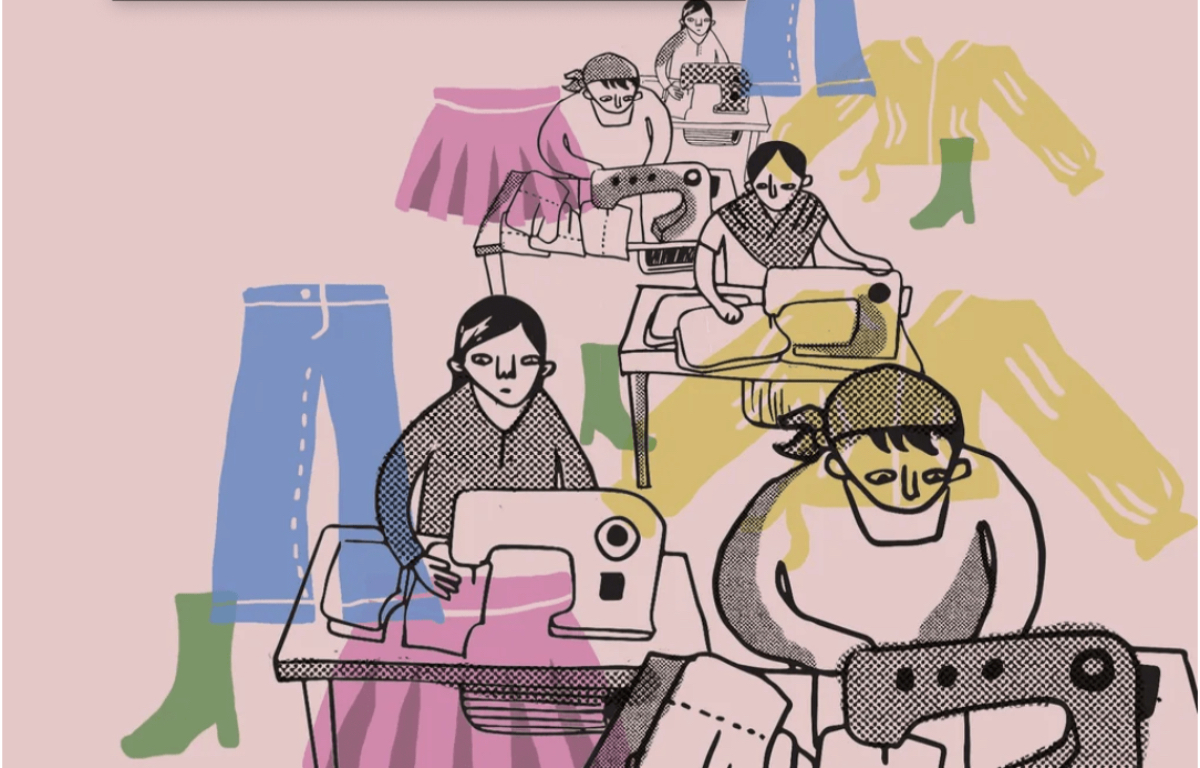
In the industrial outskirts of Prato, Italy, and the quiet textile towns of northern Portugal, a paradox defines the fashion industry of 2026. While European consumers browse racks of $5 t-shirts and $10 dresses labeled “Made in Italy” or “Made in Portugal,” the workers sewing these garments are overwhelmingly migrant women trapped in a system of systematic exploitation. By mid-2026, approximately eighty percent of garment workers in the EU’s fast-fashion hubs are female migrants from China, Bangladesh, Pakistan, Brazil, and Eastern Europe. These women endure twelve-hour shifts seven days a week, working in cramped, poorly ventilated workshops where safety standards are ignored and wages hover between €600 and €800 a month—amounts that fall far below national poverty thresholds despite their labor fueling a multi-billion euro industry. The speed at which brands like Shein and Zara demand new collections has intensified this pressure, creating a supply chain where the urgency of the algorithm overrides the dignity of the human hand.
The business models of these giants rely on a complex web of subcontractors that obscure responsibility while maximizing profit margins. Investigations into Shein’s supply chain in early 2026 revealed that factories supplying the Chinese giant often force workers to clock seventy-five hours a week under a piece-rate system that keeps earnings barely above legal minimums, regardless of the intensity of labor required. In Prato, a city historically known for high-quality wool production but now transformed into a low-cost manufacturing hub, female workers report being paid per item sewn rather than by the hour, incentivizing dangerous speed and eliminating breaks. Similar conditions persist in Portugal’s Porto and Vila Nova de Famalicão regions, where Brazilian and Cape Verdean women face informal contracts that deny them social security, health insurance, or recourse for workplace injuries. The gendered nature of this exploitation is explicit; women are targeted because they are perceived as more compliant, less likely to unionize due to language barriers or fear of deportation, and willing to accept lower wages than male counterparts. This dynamic creates a workforce that is both economically vulnerable and politically voiceless, bearing the brunt of an industry that thrives on disposability.
European Union trade policies have historically enabled this structure by prioritizing market access over labor rights enforcement. While the EU launched its Strategy for Sustainable and Circular Textiles and introduced the Corporate Sustainability Due Diligence Directive (CSDDD) to mandate human-rights mapping in supply chains, implementation remains fraught with loopholes. The CSDDD requires large apparel exporters to prevent and mitigate risks like forced labor and sub-minimum wages, yet the burden of proof often falls on the victims rather than the brands. The Digital Product Passport, scheduled for full rollout in 2026, promises to embed verified information on labor standards, but early critiques suggest it may become a bureaucratic exercise rather than a tool for real-time accountability. Furthermore, the EU’s trade agreements with non-EU countries frequently lack binding mechanisms to penalize suppliers who violate labor laws, allowing brands to shift production to the lowest-cost locations without facing sanctions. The Waste Framework Directive and the July 2026 ban on destroying unsold clothing attempt to address the environmental fallout of overproduction, but they do not directly tackle the labor conditions that make such overproduction profitable. As a result, the structural incentives for fast fashion remain intact, with policymakers treating labor rights as a secondary concern to economic competitiveness.
Despite these formidable barriers, a wave of resistance is rising from the factory floors themselves. In Prato, immigrant workers—led by women and organized through militant unions like SUDD Cobas—launched a historic series of strikes in 2025 demanding the right to a forty-hour work week. Their campaign, dubbed the “8×5 movement” (eight hours, five days), secured victories in roughly seventy factories within just fourteen weeks, forcing employers to abandon the grueling twelve-hour schedules that had defined the region for decades. These strikes were not isolated incidents but part of a broader mobilization that included a nationwide strike on International Women’s Day to spotlight persistent gender inequality in the sector. Similarly, in Portugal, female garment workers in Guimarães and Felgueiras began protesting in late 2025 over unequal pay, inadequate maternity leave, and unsafe conditions, escalating to sector-wide strikes that continued into 2026. These actions have forced negotiations with employers and government authorities, demonstrating that even the most marginalized workers can disrupt the fragile logistics of fast fashion when they organize across linguistic and cultural divides.
The significance of these protests extends beyond immediate wage gains; they represent a fundamental challenge to the racialized and gendered hierarchies of the global textile industry. By centering the voices of migrant women, these movements expose the contradiction between the EU’s rhetorical commitment to human rights and the reality of its consumption patterns. The organizers are not merely asking for better pay but for recognition of their labor as essential to the economy and their personhood as worthy of protection. They are building networks that connect workers across borders, sharing strategies for collective bargaining and leveraging digital platforms to bypass traditional media gatekeepers. Their success hinges on sustained solidarity, ensuring that the momentum of 2025 does not dissipate as brands attempt to relocate production once again. Without such persistence, the cycle of exploitation will continue, feeding off the vulnerability of those who have nowhere else to turn.
As 2026 progresses, the trajectory of the fast-fashion industry depends on whether the EU can translate its regulatory frameworks into enforceable protections that reach the workshop floor. The existence of laws like the CSDDD and the Digital Product Passport offers a potential pathway, but only if coupled with robust inspection regimes, meaningful penalties for non-compliance, and support for worker-led organizing. Until then, the clothes hanging in European stores will remain stained with the sweat and silence of women whose labor is rendered invisible by the very systems that depend on it. The choice facing consumers, policymakers, and the industry is clear: either we dismantle the structures that allow for this exploitation or we acknowledge that our wardrobe comes at the cost of human dignity. The strikes in Prato and Portugal prove that change is possible, but it requires more than policy tweaks. It demands a fundamental reimagining of value, where the price of a garment reflects not just the cost of materials but the worth of the hands that made it.